
First published by The Journal Gazette
The secret is out! Molly, my interpreter and tour guide with Pinglin Tea Culture and Maokong Guided Day Tour, spilled the tea on Taiwan teas.
Our first stop was to visit a tea vendor outside of Taipei, on the upper side of the Maokong mountain. It was next to the magnificent Zhangshan Temple. There was a six-shelf metal storage rack filled with a variety of old, tea-stained mugs for community use. I grabbed a white mug with red, faded “Merry Christmas.” I placed the mug under an old three-gallon metal beverage container labeled “Tieguan Tea” and filled it half way. We walked to the standing area and looked down at Taipei City.
“You’re drinking a tea that is part of the oolong tea family,” Molly said. “The secret to our high-quality oolong tea is that the leaves are grown at high elevations.”
Next to the Tieguan Tea container was an old two-gallon metal beverage container labeled “warm water.” I could use it to water down my tea, but I told Molly it tasted great the way it was. That was the answer she wanted to hear. I was on my way to becoming a tea connoisseur.
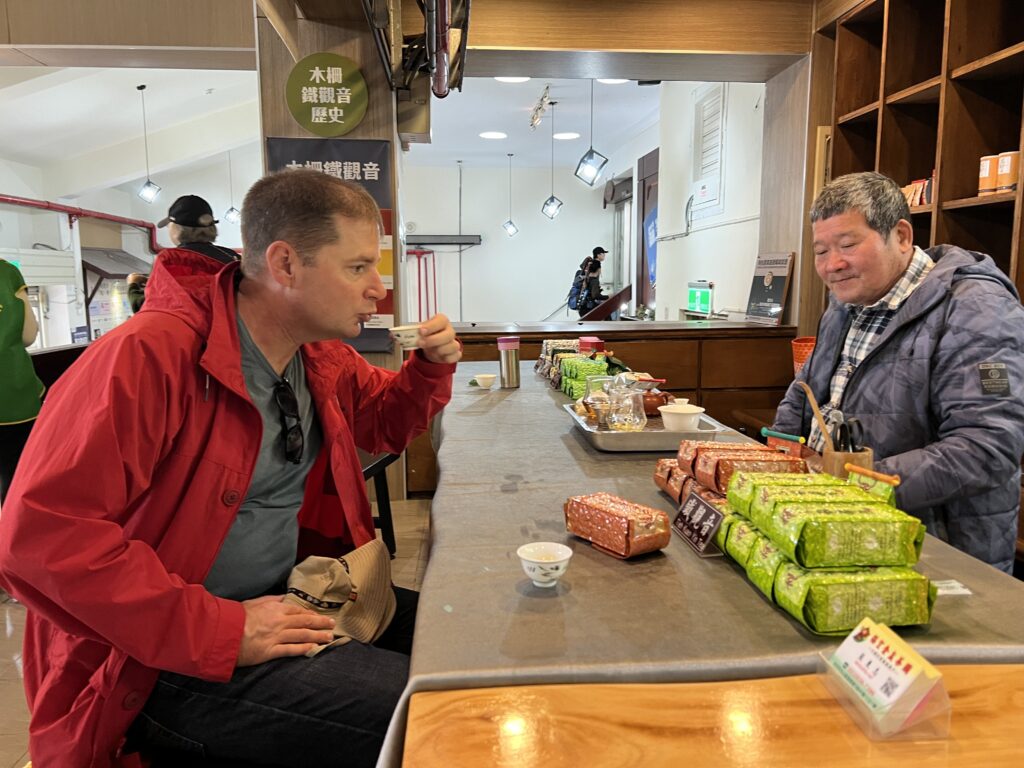
Next we went to Taipei Tea Promotion Center for Tie Guanyin and Baozhong teas. It has a section dedicated to the area’s history in tea farming, tea-production process and tea-tasting methods. Tea leaves are displayed to show various varieties.
Molly introduced me to Mr. John, who is a tea farmer specializing in morning teas. Our language barrier lent itself to me reading his nonverbal communications. There were two small tea cups in front of me. One with green tea and the other with black tea. I followed Mr. John’s lead by drinking first the black tea and then green tea.
“You drink first the tea without caffeine,” Molly said. “That’s the black tea. And then you drink tea with caffeine. That’s the green tea. That way the caffeine doesn’t ruin the taste of the black tea.”
I then wet my whistle with a sip of water. I did ask for more green tea. I could feel the caffeine, and knew I was going to have trouble sleeping.
The beautiful tea-growing region had a pleasant, earthy smell and was surprisingly quiet as we walked around before heading to the famous Maokong Gondola to ride it down the mountain. The lift transportation system provides breathtaking views.
We then took a van to Pinglin Old Street where I met Mr. Wong, a young-looking 75-year-old who has been brewing tea for half a century. I sat on one side of a small table where there was a tea cup with saucer and a tea tray set. He introduced me to honey-scented black tea and how to drink it.
Mr. Wong boiled water in a miniature teapot, poured the water out into a small glass, filled the teapot with tea leaves and then poured the water back into the teapot. After 30 seconds, he poured the tea into my teacup. I could see steam. He instructed me to follow his lead. He took his saucer, placed it on top of his cup, and then gently twisted it in a full 360-degree circle. When I did it, a tiny amount of tea leaked out between the cup top and saucer. I couldn’t smell honey, just a pleasant scent.
Mr. Wong drank a little of his tea, swished it in his mouth and then sucked the tea in his bottom teeth. Following his example, I could taste small amounts of honey.
He then took his warm empty tea cup and rolled it on his face.
“That’s to fight wrinkles,” Molly said. “That’s his secret to looking young.”
Molly then took me to the scenic Thousand Island Lake.
“There aren’t a thousand islands,” Molly said. “Just a lot of rocks on the lake’s surface.”
We walked around the surrounding tea plantations where people work the fields.
“The industry here is either tea farming or get a job in the city,” Molly said. “It’s hard to find young people that want to tea farm. The people that work the fields are older.”
This breathtaking area right outside of Taipei is not the only place in Taiwan where there is beautiful nature.
The next day I took the Shifen, Jiufen and Yehliu Guided Day Trip.
Shifen is a small town with one railroad track that runs down the center of its narrow main street. There are two- and three-story buildings with vendors on first floors facing each other. It’s a popular place to release sky lanterns that contain handwritten wishes.
Just outside of Shifen is the Shifen Waterfall. It is not big, but it does attract tourists.
We then went to Jiufen, a beautiful town on the side of a mountain. There are a lot of stairs to climb to get to the coffee and tea shops, restaurants and souvenir shops. The narrow walkways can get crowded, so patience is necessary.
Our next stop was Yehliu Geopark. It’s known for its sea-erosion landscape. CNN said about the area, “this is the closest you’ll get to Mars on Earth.” The popular Queen’s Head Rock is the area’s biggest attraction.
We ended the tour at the popular Raohe St. Night Market in Taipei. I just walked around. None of the food looked appetizing to me. While in Taiwan, I got my food from McDonald’s, Starbucks and 7-Eleven. I not embarrassed to admit that when it comes to food and travel, I go with what I know.