
First published by The Journal Gazette
I was standing on the port side of the Garinko III IMERU ice breaker in the Abashiri region of Japan. I wanted to experience what it was like moving through the calm, ice-covered Sea of Okhotsk.
There was a twist to this trip: everyone spoke Japanese but me. No one could understand what I said. I couldn’t understand what passengers said. But I wasn’t uncomfortable. I’ve sailed in these kinds of glacial waters before. I took comfort in the fact that we all wanted these memorable experiences and that we all wanted to safely return to the shore.
I could hear the cracks and pops from ice as the front of the bright red special-purpose ship slowly slid onto sheets of ice. I could hear the ship’s huge drills on each side ripping the ice and pushing the pieces away from the ship’s path. The port and starboard sides had narrow areas where eager sightseers leaned on the ship’s railing as they looked out.
A few foolhardy sightseers bent over the railing and pointed their cameras directly below at the ice in the water. I wasn’t willing to take that risk that the ship might hit unexpected rough waters or a thick patch of ice. I know it isn’t safe if a human body falls in freezing waters.
To escape the cold, some people trickled into the heated cabin where there was an observation area. But the first group to retreat from the cold stood in the limited number of spots by windows. That left some people who retreated later with obscured views and denying them the experience to clearly see picturesque views. There is a lesson here: Retreating first can provide advantages over others who retreat later.
I only temporarily went inside when I began to shiver. I didn’t travel all this way to see the inside of the ship or stand behind someone. I wanted to see Japan. I had to stand outside.
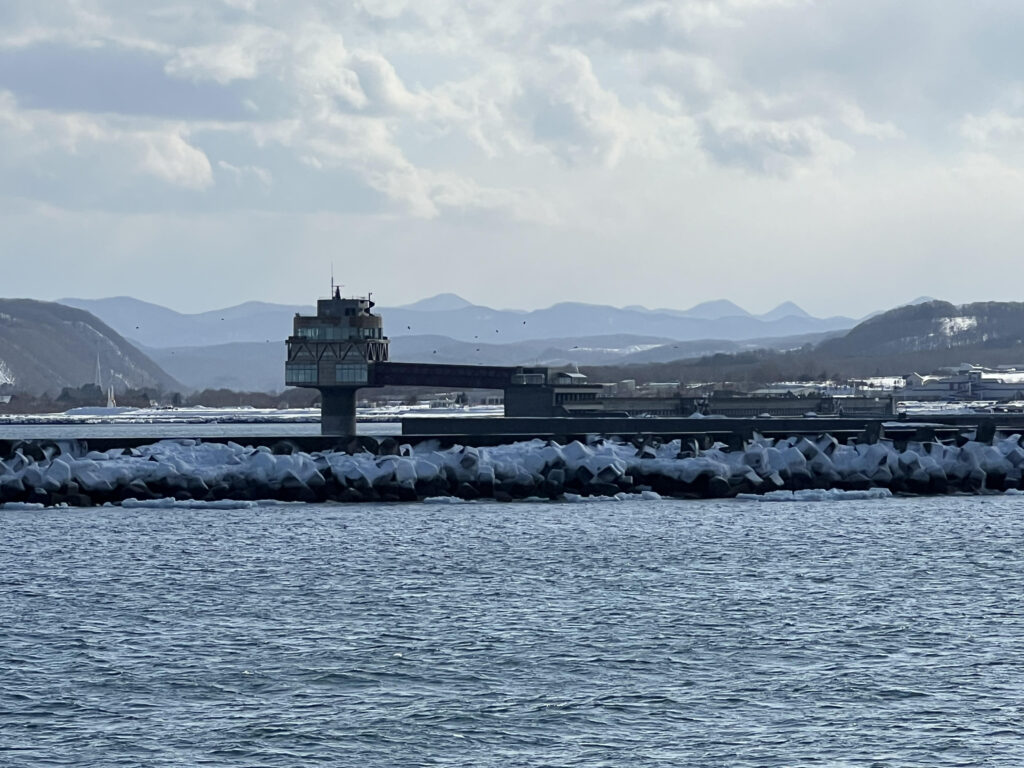
There were two sets of concrete breakwater blocks that stretched out from the shore and curved toward each other, creating a narrow path of freedom that opened onto the ocean. The ship slowly moved through the opening. There was a beautiful white lighthouse on one side and a red lighthouse on the other. The bright blue sky had puffy white clouds. In the distance were small mountains with snowcaps.
The one-hour sea adventure made one circle at sea. When we got off the ship, we were greeted by dockworkers and our tour guide. We got back on a bus, and five hours later we returned to Sapporo where we started.
Japan is made up of five main islands. From north to south, they are Hokkaido, Honshu, Shikoku, Kyushu and Okinawa. I was staying in Sapporo, the capital city of Hokkaido.
I went to Hokkaido Jingu. It’s a popular shrine associated with the ancient religion of Shinto. The A-frame wood building has a black roof and gold markings. The tone of the gold complements the brown color of the building and the roof. It sits in a forest at the bottom of a mountain at the edge of town. I went during the winter. The area’s beauty was enhanced by snow.
The Sapporo TV Tower was next on my list. It’s located in the center of the city. I took the 60-second ride to the top where I got a stunning 360-degree panoramic view of the city and the further outskirts, including the western and southern snowcapped mountain range. But be warned: It’s a popular tourist destination with plenty of souvenir shops.
Eventually I ditched the list of tourist attractions, and I wandered the streets of Sapporo. There was at least 4 inches of snow on the ground. Some people shoveled their driveways and sidewalks while others did not. People drove cautiously and slowly on the roads.
In front of the popular train station, there was salt on icy sidewalks. The parking lots of grocery stores were packed. There were kids throwing snowballs at each other. The people of wintry Sapporo reacted to snow like people in wintry regions of the United States.
Travel often exposes differences in societies, but it also exposes similarities. It’s these similarities that should remind us of how much alike we are even if we talk or look different.